
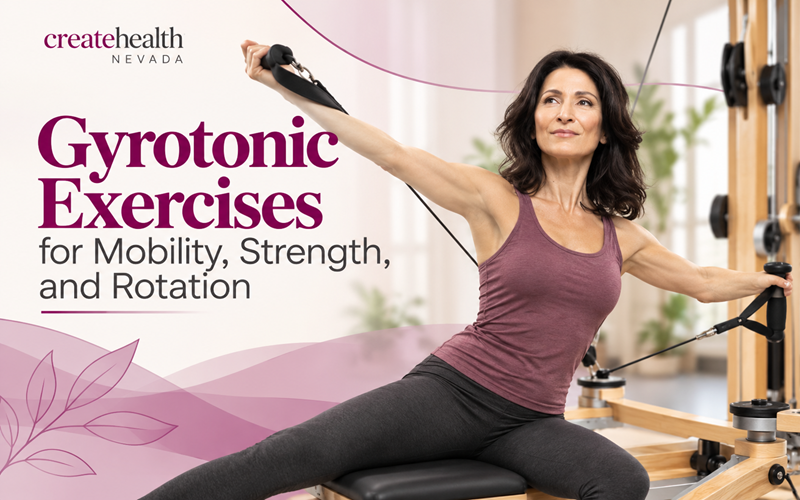
Gyrotonic exercises use flowing, circular, and spiraling movements to build strength, mobility, and control through your whole body. They train your spine and joints to move in many directions, not just forward and back. If you feel stiff when you twist, reach, or turn, Gyrotonic may be worth a try.
Most workouts move you in straight lines. Your body, however, was built to rotate.
Our Gyrotonic Training sessions guide you through these movements with the right resistance and breathing. You build strength while your body relearns how to twist, turn, and reach with ease.
Schedule a Gyrotonic Training Session to start moving in every direction your body was built for.
What Are Gyrotonic Exercises?
Gyrotonic is a special type of exercise invented by Julius Horvath, who used to be a dancer and gymnast. He created it when his career as a performer was cut short due to injuries, and he had to develop his body again.
Gyrotonic is performed with the use of special equipment. The main device employs a pulley system, weights, and rotating handles that help you move in a smooth way.
There is also Gyrokinesis, which does not require any equipment. It is done on a stool or on a mat, where you use your body to repeat the same pattern of movements.
At first glance, Gyrokinesis may seem like a combination of Pilates, yoga, dancing, and swimming. However, it has its own rhythm. Movements are never stopped abruptly, but one movement smoothly passes into another like waves.
Why Does Moving in Circles Matter?
Consider the most recent workout session that you had. Was it walking on a treadmill, riding a bike, or doing some squats?
All of these movements involve moving the body in one way or another, either forward and backward or up and down.
What about daily movements? You rotate to put on a seatbelt, twist to check your blind spot, stretch to take something from the back seat, or take a baby out of his car seat. There is no straight path here.
This is what your body is meant to do. The joints at the hips and shoulders allow for rotating motions, and the spine can bend, arch, twist, or bend to one side.
However, in most cases, we never use the full potential of our body. We only sit, stand, walk, or perform workouts where we move in straight lines. With time, we get used to certain movements, and other motions become uncomfortable and awkward for us.
That’s where the Gyrotonic exercises are different, as almost each of them involves rotating, spiraling, or circling of the body parts.
How Do Gyrotonic Exercises Work?
Gyrotonic combines flowing movement, guided resistance, and breathing. Here is what happens during a typical session.
1. Your Spine Moves in Waves
Many exercises start with your spine. You might arch your back, curl forward, twist, or lean to the side, often in one continuous motion.
For example, you may sit on the bench, hold the handles, and slowly roll your spine forward and back like a wave. The movement looks simple, but it asks each part of your back to take part.
2. The Equipment Guides and Challenges You
The pulleys and handles support your movement while adding light resistance. This helps you move through a range of motion with more control.
The resistance can be adjusted. A trainer may make an exercise easier while you learn it, then add more challenge as you get stronger.
3. Your Breathing Follows the Movement
Gyrotonic uses specific breathing patterns that match each movement. You may breathe in as you open your chest and breathe out as you curl forward.
This helps you stay relaxed and keeps the movement smooth instead of rushed.
4. Your Whole Body Works Together
In Gyrotonic, a movement rarely belongs to just one body part. When you reach with your arm, your shoulder blade, ribs, and spine move with it.
This can help you notice how one area affects another. A stiff upper back, for instance, may be part of the reason your shoulder feels tight when you reach overhead.
What Are the Benefits of Gyrotonic Exercises?
Gyrotonic may help you move with more ease, strength, and control. Results depend on your body, your goals, and how often you practice.
1. It Works on Mobility and Strength Together
Stretching alone can increase how far you move. But you also need strength to control that range.
Gyrotonic trains both at once. The equipment gives you light resistance while you move through large, circular motions.
2. It Is Gentle on Your Joints
There is no jumping or pounding. The movements are smooth, and the equipment supports your body.
This can make it a good option if high-impact workouts feel too hard on your knees, hips, or back.
3. It Helps With Coordination and Body Awareness
Because your whole body moves together, you learn to notice how your spine, hips, and shoulders connect.
You may start to catch habits your unconscious mind has been running for years, like holding your breath when you reach or locking your lower back when you turn.
4. It Keeps Workouts Interesting
If repetitive workouts bore you, Gyrotonic offers something different. The flowing patterns can feel more like dancing than counting reps.
Research on Gyrotonic is still limited, and most studies so far have been small. Much of what we know comes from trainers and people who practice it.
That’s why it’s best to try it with a certified trainer and pay attention to how your body responds.
Gyrotonic vs Pilates vs Yoga: How Do They Compare?
All three can support mobility and strength. The biggest difference, whether you compare Gyrotonic vs Pilates or either one with yoga, is how they move your body.
| Area | Gyrotonic | Pilates | Yoga |
| Movement style | Circular, spiraling, and wave-like | Controlled and precise | Held poses or flowing sequences |
| Spine work | Arching, curling, twisting, and side bending in one flow | Core control while the spine moves | Forward folds, backbends, and twists |
| Rotation | Built into almost every exercise | Included in some exercises | Included in twisting poses |
| Strength | Light resistance through pulleys and weights | Core and muscle control | Body weight, depending on the style |
| Flexibility | Through large, flowing movements | Through controlled movement | Often includes dedicated stretching |
| Equipment | Specialized pulley machine, or a stool for Gyrokinesis | A mat, bands, or a reformer | A mat, with optional blocks and straps |
| Where to practice | Mostly in studios with certified trainers | Studios, at home, or online | Studios, at home, or online |
Keep in mind that classes vary a lot. A gentle yoga class may feel nothing like a fast flow class, and a mat Pilates session can differ from a reformer class.
Who Might Benefit From Gyrotonic Exercises?
Gyrotonic can benefit various individuals; however, it would particularly benefit you if your body is always stuck in just a few positions.
If you spend hours sitting at your desk or driving, Gyrotonic helps your back move in ways it does not otherwise.
If you have hobbies such as playing golf, tennis, or pickleball, Gyrotonic helps you train for twisting and turning moves.
Dancers use Gyrotonic to train their movements better; moreover, people who get bored while working out normally simply enjoy Gyrotonic.
Is Gyrotonic Safe for Everyone?
Gyrotonic exercise is low impact, but this does not mean that all the exercises are suitable for all people.
Back pain is one of the most common reasons people look for gentler ways to move. According to the World Health Organization, low back pain affected about 619 million people worldwide in 2020, and it is the leading cause of disability globally.
If back pain is part of why you are interested in Gyrotonic, take a few precautions first.
Consult your doctor before beginning the exercises if you recently had an operation or an injury, joint replacement, osteoporosis, or chronic back and neck pain.
Your instructor can modify the exercises for you. Cease any exercise that causes you sharp pain, and do not stretch yourself to a point that does not feel right.
If you experience sudden pain in your back or neck, accompanied by weakness, numbness, or difficulties urinating or defecating, seek immediate medical help.
What If Your Body Still Won’t Turn the Way You Want It To?
Sometimes you can practice regularly and still feel blocked in certain directions.
Twisting to one side feels easy, but the other side feels stuck. Or you can reach forward with no trouble, yet turning your head to check traffic still feels tight.
At Create Health Nevada, SomaFlow Therapy™ takes a whole-body approach to movement restrictions and areas of tension.
Instead of focusing only on where you feel stuck, the practitioner looks at how different parts of your body work together.
For example, if turning to look over your shoulder feels hard, they may also look at how your ribs, upper back, and hips move during that turn.
SomaFlow is different from Gyrotonic, Pilates, and yoga, and it isn’t a replacement for medical care. Whether it’s suitable for you depends on your needs.
If stiffness or limited rotation makes everyday activities difficult, contact Create Health Nevada to discuss your concerns and see whether SomaFlow Therapy™ may be right for you.
People Also Ask
What are Gyrotonic exercises good for?
Gyrotonic exercises can help improve mobility, strength, coordination, and body awareness through circular and spiraling movements.
Is Gyrotonic better than Pilates?
Neither is better for everyone. Gyrotonic focuses more on rotation and flowing movement, while Pilates focuses on core strength and precise control.
What is the difference between Gyrotonic and Gyrokinesis?
Gyrotonic uses specialized pulley equipment. Gyrokinesis uses similar movements but is done on a stool or mat without machines.
Is Gyrotonic good for beginners?
Yes, Gyrotonic can suit beginners because a certified trainer can adjust the resistance and movements to your level.
Is SomaFlow Therapy™ the same as Gyrotonic?
No. Gyrotonic is an exercise method, while SomaFlow Therapy™ looks at how your whole body moves and where tension may be limiting you.