
If you’re looking for a gentle way to ease an aching back, Pilates is one of the most beginner-friendly places to start, especially for the everyday kind of back pain that has no single clear cause.
If your back aches after a long day at the desk, feels stiff when you get out of bed, or makes you nervous to bend and lift, you’re not alone. Lower back pain is one of the most common reasons adults stop moving. And here’s the tricky part: your lower back is often the place that complains, not the place where the problem starts.
That’s why slow, mindful movement can help so much.
At Create Health Nevada, Shoshi Hall has spent more than 40 years helping people move with less pain and more confidence.
If you’d like someone to guide you from day one, book a consultation for private or virtual Pilates.
Is Pilates Good for Lower Back Pain?
Pilates can help many people with chronic, non-specific lower back pain. Research shows it reduces pain more than doing little or no exercise, but it isn’t proven to work better than other types of exercise. That means the type of exercise matters less than doing it consistently.
A Cochrane review of 10 trials with 510 people found that Pilates eased pain better than minimal care, though the quality of the evidence was low to moderate.
So the honest takeaway is simple: the best exercise for your back is the one you will stick with.
How Does Pilates Help an Aching Back?
Pilates helps by gently strengthening the muscles that support your spine, bringing back easy movement, and changing the everyday habits that load your lower back.
Deep Core and Breath Support
Pilates works the deep muscles around your spine, like the transversus abdominis and multifidus. You won’t find these with crunches. They switch on quietly, often with a slow exhale, and give your back steady support.
Spinal Mobility
Many Pilates moves roll the spine one segment at a time. This helps stiff areas start moving again, so one small part of your back isn’t stuck doing all the work.
Hips, Posture and Compensation Patterns
Tight hips, shallow breathing or habits left over from an old injury can quietly shift strain into your lower back. Good Pilates teaching looks at the whole body, not just the sore spot.
Before You Start: Safety and Red Flags
First, make sure your back pain is the kind that’s safe to exercise with. See a doctor or physical therapist before you start if you have numbness or leg weakness, changes in bladder or bowel control, fever, unexplained weight loss, or pain that began after a fall or accident.
Then follow one simple pain rule: mild effort or a gentle stretch is fine. If your pain is sharp, shooting, or spreading, or gets worse while you are exercising, stop.
Take extra care, and check with your doctor or physical therapist first, if you have a herniated disc, sciatica, a spinal fusion or osteoporosis, or if you’re pregnant.
6 Pilates Exercises for Lower Back Pain
These six exercises are gentle and beginner-friendly, done lying on your back, on your belly or on all fours. Take your time and breathe throughout the exercises.
1. Pelvic Tilt With Breathing
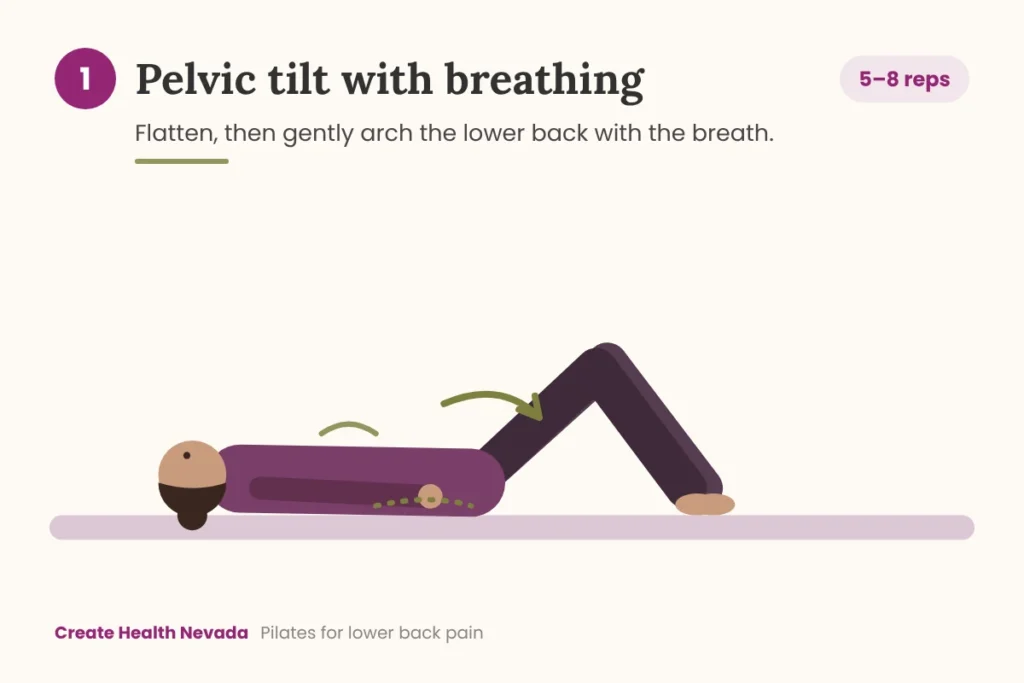
Wakes up your deep core and gently moves your lower back. Lie on your back with your knees bent and feet flat. Take a breath in to prepare.
As you exhale, tuck your pelvis in so that your lower back region slightly flattens onto the mat.
Inhale back to a neutral spine and repeat for 5-8 repetitions. If you have tightness in your neck, place a small cushion behind your head.
2. Pelvic Curl
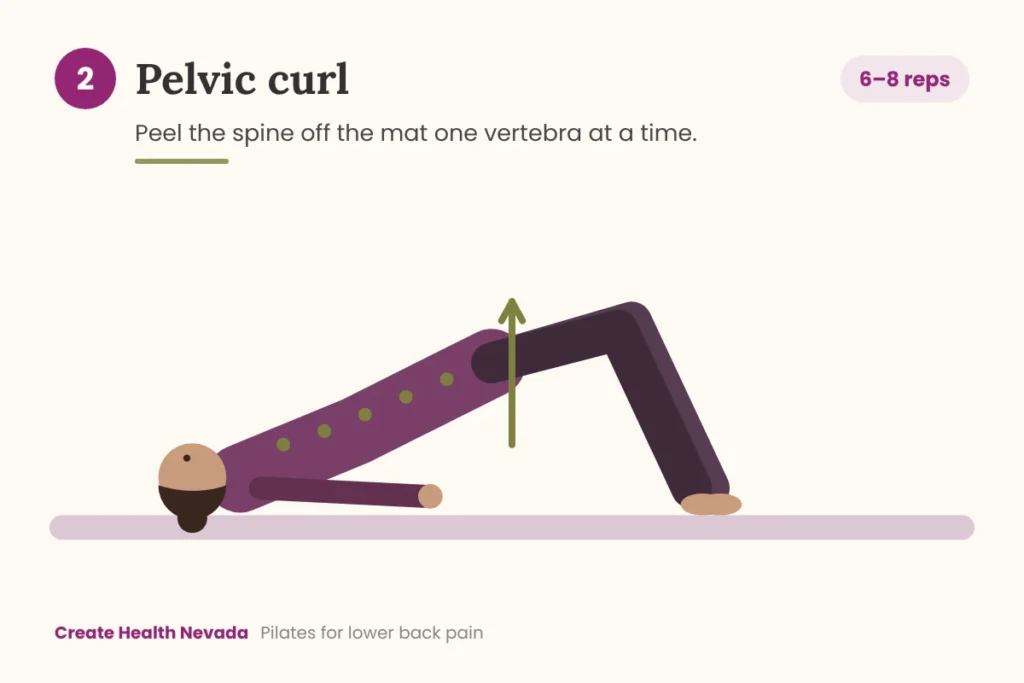
Builds on the pelvic tilt to move your spine one segment at a time. Lie on your back as before.
As you breathe out, tilt your pelvis and begin lifting your spine off the ground one vertebra at a time until you can only feel your shoulder blades touching the mat.
Inhale while at the top of the move and then slowly exhale while rolling down to start all over again. Repeat 6-8 times.
3. Knee Sways
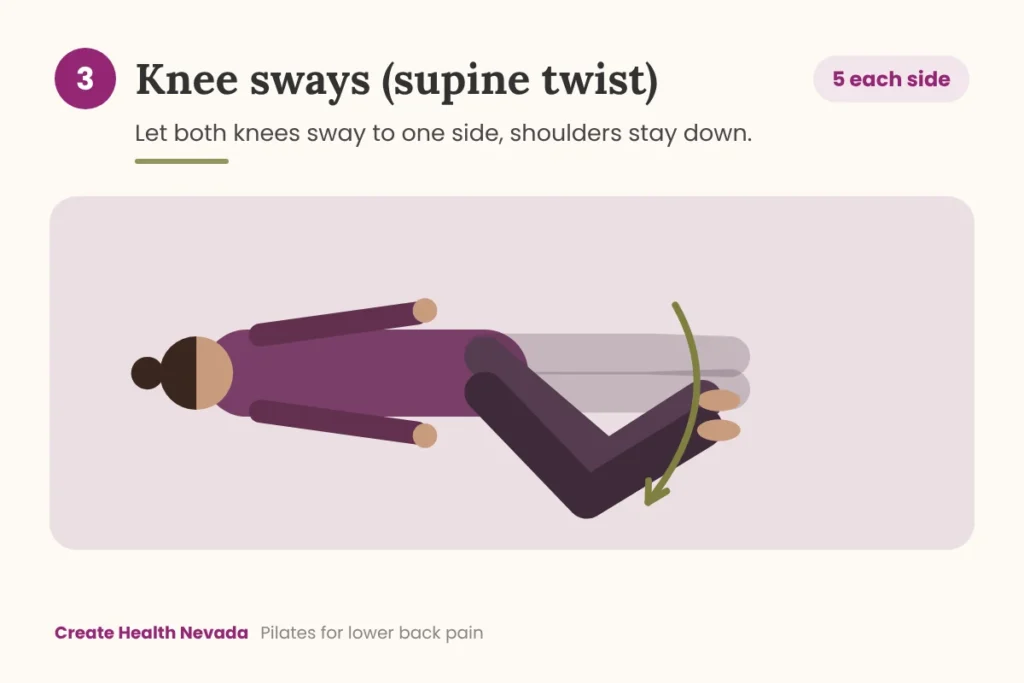
Gently loosens tightness in your lower back and hips. Start lying on your back with your knees bent and together while keeping your arms wide.
As you exhale, allow your knees to rock a bit to one side. On inhalation, rock them back into the center position. Repeat 5 times on each side.
4. Leg Slides
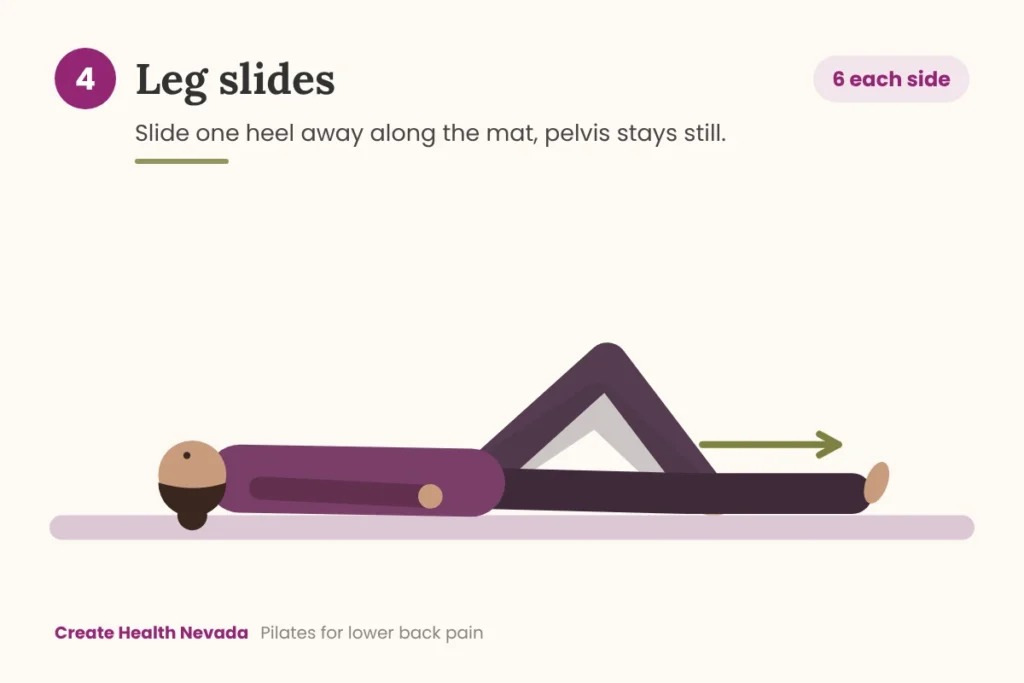
It will teach your core to maintain the stability of your pelvis while your legs are moving.
Lay on your back, bend your knees. Exhale and slide your foot on the floor slowly until your leg is straight.
Inhale and slide your leg back. Perform 6 reps on each leg, maintaining the stability of your pelvis. If your back is arching, slide half way.
5. Bird Dog
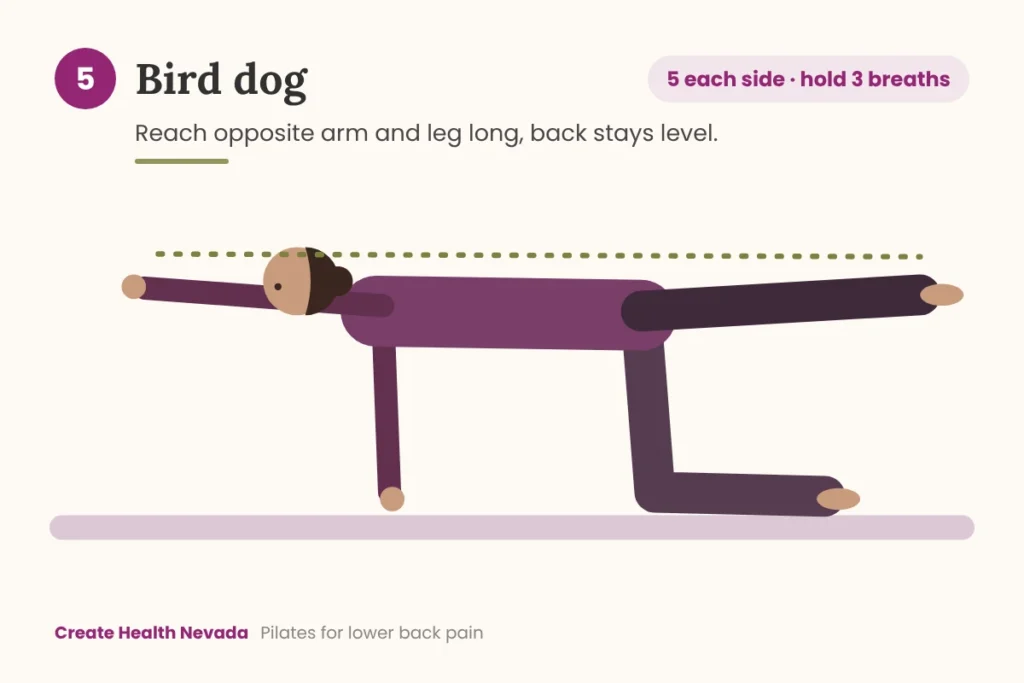
Strengthens your core and back while your spine stays supported. Start on your hands and knees, hands under shoulders and knees under hips.
As you exhale, reach one arm forward and the opposite leg back. Hold for 3 slow breaths, then return as you inhale.
Repeat 5 times on each side. Keep your hips level, and only reach as far as you can without your back sagging.
6. Swan Prep
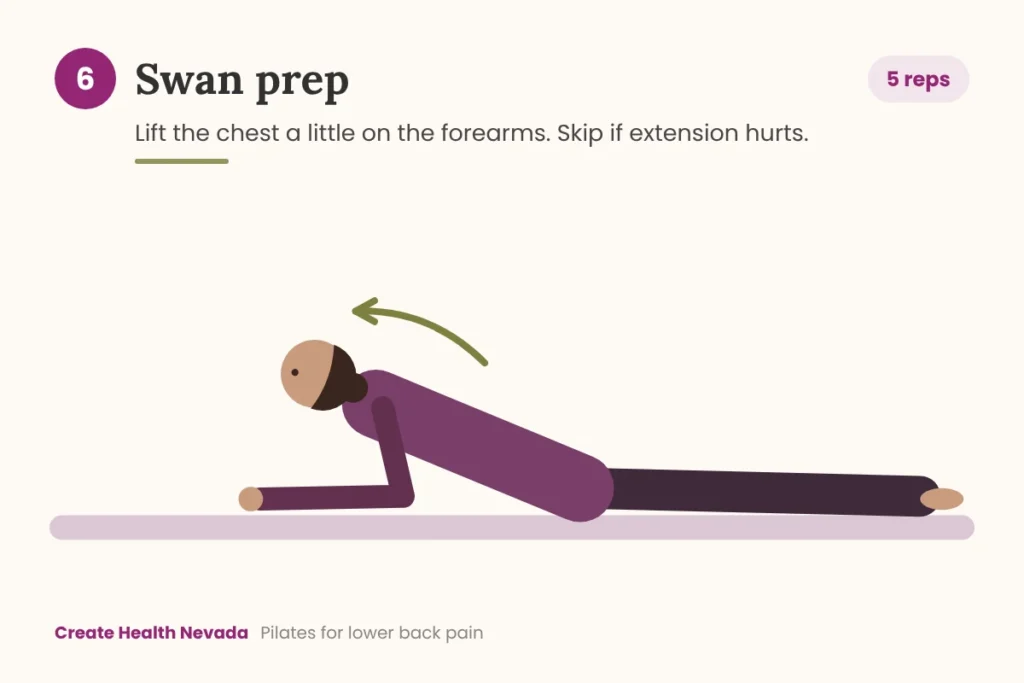
A gentle backbend that balances out all the forward bending we do each day. Start lying flat on your belly with hands under shoulders and forehead against the floor.
Inhale and lift your head and chest several inches by contracting your back muscles rather than relying on arm strength.
Exhale and return. Repeat 5 times. Avoid if you have any pain when bending backwards.
How Often Should You Do Pilates for Back Pain?
Start with 10 to 15 minutes, three times a week, and slowly build up to 30 to 45 minutes over 4 to 8 weeks. Rest days matter just as much as practice days.
| Day | Exercises | Minutes |
| Monday | Pelvic tilt, pelvic curl, knee sways | 10 |
| Wednesday | Pelvic tilt, leg slides, bird dog | 10 to 15 |
| Friday | All six exercises | 15 |
When this starts to feel easy, add a few reps or a few minutes each week.
Mat, Reformer or Private Pilates for Back Pain?
If your back pain keeps coming back, one-to-one sessions are the best place to start, because a teacher can tailor each move to your back.
| Option | Support level | Best for | Cost and access |
| Home mat | Little guidance | Mild pain, knows the basics | Free, anytime |
| Group mat class | Some guidance | Mild pain, enjoys a group | Low cost, set times |
| Reformer | Springs support each move | Needing support or variety | Higher cost, studio only |
| Private or virtual one-to-one | Fully tailored | Ongoing pain, past injury, worries about moving | Highest cost, flexible |
Our private Pilates sessions let us watch exactly how you move and adjust things on the spot.
If you can’t come to the studio, virtual Pilates brings that same personal attention into your living room.
Our Whole-Body Approach to Back Pain
At Create Health Nevada, we don’t treat your lower back as a separate problem. Alongside Pilates, we use Gyrotonic training for smooth, spiraling movement through the spine, and SomaFlow Therapy™ to explore fascia, breath and the movement habits that keep pain coming back.
Together, they help us find where the strain really begins.
Start Gently, Stay Consistent
Pilates for lower back pain works best when you start slowly, practice often and listen to what your body tells you. You don’t need to do everything at once. A few careful minutes today is a great beginning.
Ready for support that fits your back? Book a consultation for private or virtual Pilates.
This article is for educational purposes only and is not medical advice. If you have severe, new, or worsening back pain, please see a doctor or physical therapist before starting any exercise program.
Frequently Asked Questions
Can Pilates make lower back pain worse?
It can if you push too hard or rush the basics. Start gently, follow the pain rule, and stop any move that causes sharp or spreading pain.
Is Pilates or yoga better for lower back pain?
Research suggests both can help with similar results. Pilates focuses more on core control, while yoga uses more stretching. If you like slow, controlled strength work, start with Pilates; if you prefer longer stretches, try yoga.
Is reformer Pilates safe with a herniated disc or sciatica?
It can be, with the right guidance. The springs offer support, but some moves need changing. Check with your clinician and work with an experienced teacher first.
How long until Pilates helps back pain?
Many people notice small changes within a few weeks of regular practice. Bigger improvements in pain and movement often take around 6 to 8 weeks.