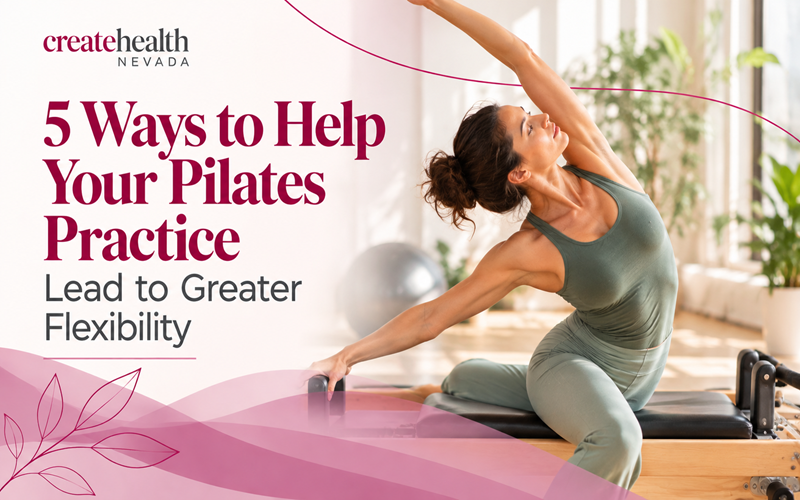
Pilates can help improve flexibility by combining controlled movement with strength, mobility, and body awareness.
Maybe your hamstrings feel tight, your hips feel stiff, or you can barely reach your toes. You may even watch someone in a Pilates class move easily into a position that feels impossible for you.
You do not have to be naturally flexible to start Pilates. With regular practice, you can gradually develop greater range of motion and control.
At Create Health Nevada, we offer personalized Pilates to help you work toward your individual movement goals. You can also practice from home through our Virtual Pilates classes.
What Does Flexibility Really Mean?
Flexibility is often described as the ability of a joint or group of joints to move through a range of motion.
But flexibility is not the same thing as being able to force yourself into a deep stretch.
Think about lifting your leg.
You may be able to use your hands to pull your leg higher, but that does not necessarily mean you can actively lift your leg to the same position and control it there.
That is where strength, stability, coordination, and body awareness become important.
For us, flexibility is not about trying to make your body look like someone else’s.
It is about discovering what your body is capable of and gradually creating more options for movement.
One study found improvements in hamstring flexibility after participants practiced Pilates twice a week for 12 weeks.
So don’t judge your flexibility after your first class. Give yourself several weeks of consistent practice before deciding whether your routine is helping.
5 Ways to Use Pilates to Improve Flexibility
Flexibility takes time.
You do not need to force your body into a deeper position every time you practice. Instead, you can use your Pilates practice to develop a better relationship with movement.
These are five ways to begin.
1. Start With Gentle Movement Before Stretching
If your hamstrings, hips, shoulders, or back feel tight, do not immediately force yourself into a deep stretch.
Start by moving the area gently.
For example, if your shoulders feel tight, sit or stand comfortably and make 5 to 10 slow shoulder circles in each direction. Let your shoulder blades move rather than keeping them stiff. Then slowly raise your arms overhead and notice whether they feel easier to move.
If your lower back feels stiff, lie on your back with your knees bent and feet on the floor. Slowly let both knees move a few inches from side to side. Keep the movement comfortable and controlled. You do not need to push your knees toward the floor.
For tight hips, try lying on your back and bringing one knee toward your chest. Hold it comfortably for a few breaths, then lower the leg and repeat on the other side.
The purpose is simple: warm up the movement before asking for more range.
You may find that a joint moves more easily after a few gentle repetitions than it did when you first started.
2. Use a Wall to Check Your Hamstring Flexibility
If reaching toward your toes is difficult, you do not have to force yourself into a deep forward fold. Try this simple Pilates-inspired exercise instead.
Lie on your back near a wall and place one leg up the wall. Keep the other leg comfortably bent or extended on the floor.
Start with the raised leg at an angle that feels manageable. Do not worry about getting your leg completely straight. Now gently straighten the knee as much as you comfortably can.
Hold for 10 to 20 seconds while breathing normally. Then bend the knee slightly and relax. Repeat 2 to 3 times before switching sides.
As your flexibility improves, you may gradually be able to straighten the knee more comfortably.
You can also use this position to compare your two sides.
Does one leg straighten more easily? Does one side feel tighter behind the thigh? Do you feel the stretch in your hamstring, or are you compensating by lifting your hips or tightening your lower back?
These details can tell you much more than simply asking whether you can touch your toes.
3. Practice Leg Lifts Instead of Only Stretching
If you want better flexibility, do not only stretch. Practice controlling the range of motion you already have.
Try this simple exercise.
Lie on your back with both legs extended. Keep one leg on the floor and slowly lift the other leg toward the ceiling.
Stop when you feel you have reached the comfortable limit of your movement.
Then slowly lower the leg.
Do not swing it.
Don’t pull it toward you with your hands.
And never arch your lower back to make the leg appear higher.
Try 5 slow repetitions on each side.
The goal is to see whether you can lift and lower the leg while keeping your pelvis relatively stable.
For example, you may discover that your right leg lifts higher than your left. Or perhaps one side feels strong but restricted, while the other has more range but less control.
This type of exercise combines mobility with strength and control. Over time, that can help you become more comfortable using the range of motion you have.
4. Use Your Breath During a Forward Fold
If your hamstrings feel tight when you bend forward, try changing the way you approach the stretch.
Sit on the floor with your legs extended in front of you. If sitting upright is difficult, place a folded towel or cushion underneath your hips.
Before leaning forward, take a comfortable breath in. As you exhale, slowly hinge forward from your hips. Do not try to pull your head toward your knees.
Instead, think about reaching your chest forward while keeping your spine as long as feels comfortable.
Stay there for two or three slow breaths.
Then come back up.
Repeat this 3 to 5 times.
If you notice your shoulders creeping toward your ears, your jaw tightening, or your breath becoming shallow, back off slightly.
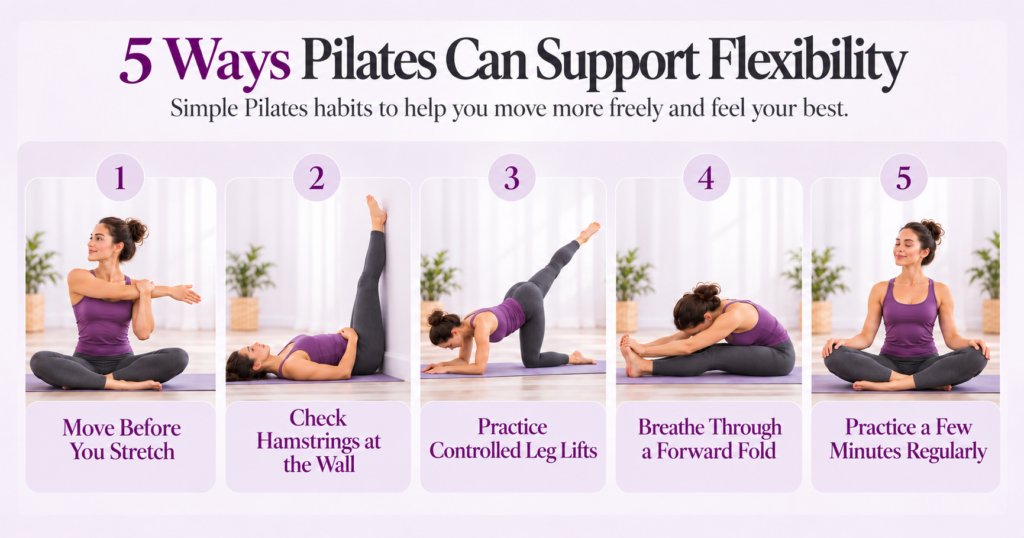
5. Practice Flexibility for a Few Minutes, Several Times a Week
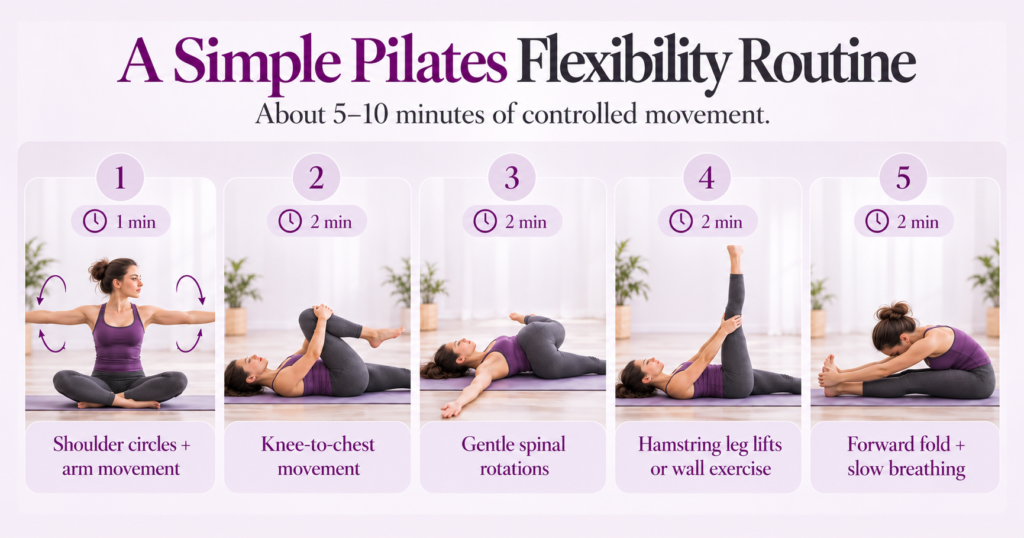
You do not need a one-hour stretching session every day to start working on flexibility. Try creating a simple 5- to 10-minute routine that you can actually repeat.
For example:
- 1 minute: Shoulder circles and gentle arm movements.
- 2 minutes: Knee-to-chest movements while lying on your back.
- 2 minutes: Gentle spinal rotations with your knees bent.
- 2 minutes: Hamstring leg lifts or the wall exercise.
- 2 minutes: A comfortable seated forward fold with slow breathing.
You can do this routine after a Pilates session, after a walk, or as a short movement break during the day. The important part is to keep the movements controlled and stay within a range that feels challenging but manageable.
For example, if you sit at a desk for several hours, you might spend five minutes moving your spine, hips, and shoulders before returning to work.
If you are a dancer, you might use a short mobility routine before rehearsal and a gentler flexibility session afterward.
If you are new to exercise, you might start with just two or three exercises rather than trying to complete the entire routine.
Personalized Pilates for Your Flexibility Goals!
Every body comes with a different history. One person may need more hip mobility. Another may need to develop strength around a joint.
Someone else may be recovering from an injury and need to rebuild confidence in movement. And another person may simply want to feel less stiff after years of sitting at a desk.
That is why a personalized approach can be valuable.
At Create Health Nevada, Pilates can be adapted around the individual rather than treating flexibility as a one-size-fits-all goal. Our work can incorporate Pilates, Gyrotonic training, movement rehabilitation, and body awareness depending on your needs and goals.
Keep Exploring Your Flexibility Through Pilates!
With regular Pilates practice, you can work on mobility while also developing strength, control, coordination, and body awareness. Research supports Pilates as one approach that may improve flexibility, although individual results can vary.
So the next time you get on the mat and discover that your body feels more like a 2×4 than a pretzel, remember that you are not failing.
At Create Health Nevada, we help you explore movement with greater awareness, strength, control, and freedom through personalized Pilates and movement work.
Schedule a session with Create Health Nevada and discover how Pilates can become part of your journey toward greater flexibility and lifelong movement.
People Also Ask
How often should I do Pilates for flexibility?
Try Pilates two to three times a week for consistent flexibility work. Regular practice can help you gradually improve your range of motion.
Is Pilates better than stretching for flexibility?
Pilates combines flexibility work with strength, control, and body awareness. Stretching focuses more directly on improving range of motion. You can use both as part of your movement routine.
Can I do Pilates if I am not flexible?
Yes. You do not need to be flexible to start Pilates. Exercises can be modified to match your current flexibility, strength, and experience.
Does Pilates help tight hips and hamstrings?
Yes, Pilates can help improve flexibility in the hips and hamstrings. If tightness is painful or continues despite regular movement, consider working with a qualified professional.
Can Pilates improve flexibility as you get older?
Yes. Pilates can help maintain or improve flexibility as you age, while also supporting strength, balance, and mobility.
How can Create Health Nevada help with flexibility?
Create Health Nevada offers personalized Pilates, Gyrotonic training, and movement rehabilitation to help you improve mobility, flexibility, strength, and body awareness.