
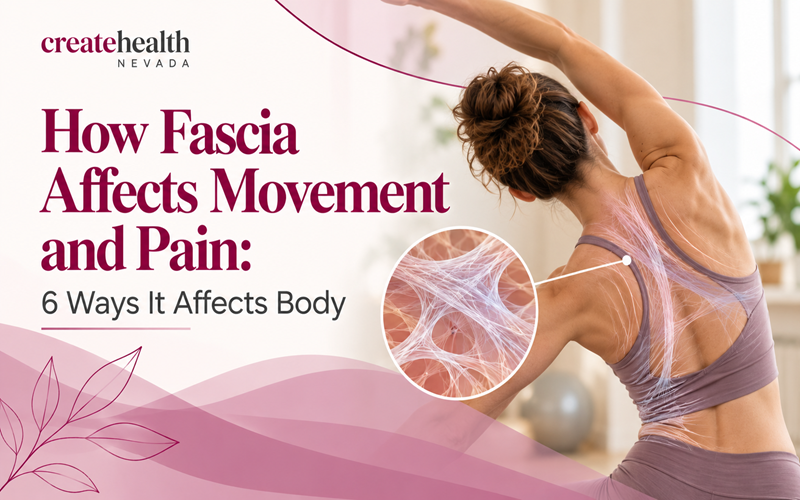
Fascia helps your body move smoothly by connecting and supporting your muscles, joints, nerves, and other tissues. When changes in fascia affect how these tissues move together, you may notice stiffness, restricted movement, or discomfort.
But pain is rarely about one tissue alone.
At Create Health Nevada, we teach health and wellness professionals how to understand fascia and develop hands-on skills through our SomaFlow™ Fascia Certification Program.
It includes techniques to work with deep tissue holding patterns and different patterns of fascial tightness.
Enroll and learn techniques that can help you improve your hands-on practice and expand the services you offer to your clients.
What Is Fascia?
Fascia consists mainly of connective tissue. You can think of it as a continuous network that wraps around and separates different structures while also connecting them.
You have fascia throughout your body. It surrounds individual muscles, groups of muscles, blood vessels, nerves, and organs. Different layers of fascia have different structures and functions.
This network helps your body maintain its structure while allowing different tissues to move relative to one another.
For example, when you walk, your hip, thigh, knee, lower leg, and foot do not move as completely separate parts. Muscles contract, joints move, connective tissues transmit forces, and your nervous system coordinates the entire action.
Fascia forms part of that system.
Fascia also contains sensory receptors that respond to pressure, stretch, and movement. These receptors can help your brain understand where your body is and how it is moving. It can contribute to pain because it contains pain-sensitive nerve endings.
How Does Fascia Affect Movement?
Healthy movement requires your tissues to move, adapt, and work together as your body responds to changing forces.
Fascia plays a role in this process.
1- Fascia Helps Connect Different Parts of the Body
Your body does not move as a collection of separate parts. When you move your arm, for example, your shoulder blade, spine, ribs, and trunk also respond to the movement.
Fascia forms part of the connective network between these structures. It helps tissues respond to mechanical loads as you move.
Imagine reaching overhead to put a box on a high shelf. Your shoulder moves upward, your upper back extends, your ribs and spine adjust, and your legs help you maintain balance.
Your body coordinates these actions rather than moving your shoulder in isolation.
Fascia contributes to the connective system that allows these different areas to work together.
2- Fascia Can Help Transmit Forces During Movement
When a muscle contracts, the force does not necessarily stay within that one muscle. Myofascial connections can help transmit mechanical forces between muscles and surrounding connective tissues.
Think about walking.
Your foot pushes against the ground, your calf muscles help move your ankle, and forces travel through your leg as you take a step. Your knee, hip, pelvis, and trunk then respond to the movement.
Fascia forms part of the network through which these forces can travel.
3- Fascia Can Influence How Freely You Move
Fascia has mechanical properties that can change with factors such as loading, movement, and tissue condition. Researchers study properties such as stiffness, tension, hydration, and tissue organization to understand how they may affect movement and physical function.
When tissues do not move or adapt well, you may notice stiffness or reduced range of motion.
You may notice that turning your upper body feels difficult after spending several hours sitting at a desk.
Several things could play a role, such as how well your joints move, how your muscles work, your daily movement habits, and how your connective tissues respond to movement.
That does not mean your fascia has simply become “stuck.” Movement involves many interacting systems.
4- Fascia Works With Your Muscles and Joints
Fascia does not move your body on its own.
Your muscles create force, your joints provide movement between bones, and your nervous system coordinates the action. Fascia forms part of the connective environment around these structures.
When you bend down to pick something up, your hips, knees, and spine change position while your muscles control the movement.
Your nervous system coordinates the timing and amount of force you use.
If one part of this system changes, your body may adjust how it moves.
This explains why restricted movement rarely comes from one structure alone.
5- Your Movement Habits Can Affect How Your Body Moves
Your body adapts to the movements and positions you use regularly.
If you spend most of your day sitting, for example, you may use a smaller range of movement than someone who regularly walks, bends, reaches, rotates, and changes positions throughout the day.
Someone who works at a desk may feel stiff when they first stand up after several hours.
Another person who frequently moves between sitting, standing, walking, and reaching may experience a different response.
The difference does not necessarily come from fascia alone. Muscles, joints, the nervous system, and movement habits all contribute.
6- Restricted Movement Can Have More Than One Cause
If you struggle to rotate your upper body, you may immediately assume that one area feels “tight.” But several factors can contribute to that restriction.
These can include joint mobility, muscle strength, previous injuries, movement habits, nervous system sensitivity, connective tissue changes, and pain or discomfort.
A person who avoids twisting after a previous back injury may become less comfortable with rotational movements.
Their muscles may change how they control the movement, their nervous system may become more protective, and their overall movement pattern may change.
Looking at the entire movement pattern can provide more useful information than focusing on fascia alone.
What Happens When Fascia Becomes Stiff?
People often use the phrase “tight fascia,” but the body does not work as simply as that phrase suggests.
Fascial tissue can become less compliant or develop changes in its structure after injury, inflammation, prolonged loading, or other physiological changes. Researchers have associated changes such as increased stiffness, fibrosis, and densification with restricted movement and pain in some musculoskeletal conditions.
When tissues do not glide or adapt well to movement, you may notice:
- Stiffness
- A reduced range of motion
- A pulling or tight sensation
- Difficulty moving through certain positions
- Discomfort during repeated movement
- Changes in how you use or load part of your body
However, stiffness does not automatically mean that fascia has “stuck together.”
Your nervous system also influences how you experience movement. Pain, fear of movement, previous injury, stress, and changes in sensitivity can affect muscle activity and movement patterns.
That is why a good movement assessment looks at the whole person rather than blaming one tissue.
Can Fascia Cause Pain?
Fascia can contribute to pain, but it represents only one possible source.
Deep fascia contains sensory nerve endings, including nociceptors. Stimulating some fascial tissues can produce pain responses, known as Myofascial Pain Syndrome. That supports the idea that fascia can act as a pain-sensitive tissue.
Still, pain does not always reflect the amount of tissue damage or stiffness.
Two people can have similar movement restrictions and experience very different levels of pain. Someone can also experience significant pain without a clear structural problem on imaging.
The nervous system plays a major role in how the body detects, interprets, and responds to sensations.
Can Movement Improve Fascial Health?
Movement gives tissues regular mechanical input.
Different types of movement expose the body to different forces. Walking, strength training, stretching, rotational movements, and controlled mobility exercises all challenge the body in different ways.
You do not need a special “fascial workout” to keep your connective tissues healthy.
Regular physical activity already gives your musculoskeletal system opportunities to adapt.
For someone with restricted movement or persistent discomfort, a movement professional may use specific exercises to gradually improve range of motion, strength, coordination, and tolerance to movement.
The goal should not simply involve “breaking up fascia.”
The goal involves helping you move better.
How Can Fascia Affect Everyday Movement?
You do not need to be an athlete to notice how your body responds to movement.
Think about sitting at a desk for several hours.
When you stand up, you may feel stiff through your hips, back, shoulders, or legs. You may need a few movements before you feel comfortable again.
That sensation does not automatically mean that your fascia has shortened.
Your muscles, joints, nervous system, circulation, and connective tissues all respond to prolonged positions and reduced movement.
Now imagine a different situation. You spend the day moving between sitting, standing, walking, reaching, bending, and lifting.
Your body experiences a wider variety of movement and mechanical loading.
This does not guarantee that you will avoid pain, but regular movement gives your body more opportunities to maintain strength, mobility, coordination, and tolerance.
How Can Create Health Nevada Help?
At Create Health Nevada, movement starts with you. The team looks at how you move, where you feel restricted, and what may affect your comfort and function.
Services such as Gyrotonic Training & Rehabilitation, Virtual Pilates, and SomaFlow Therapy™ can support mobility, strength, body awareness, and more comfortable movement.
Fascia plays an important role in how your body connects and responds to movement, but it works alongside your muscles, joints, and nervous system.
Instead of focusing only on “tight fascia,” looking at the whole movement pattern can help you build better mobility, strength, control, and confidence.
If pain, stiffness, or limited movement is affecting your daily life, book an appointment with Create Health Nevada to discuss your movement goals and find an approach that fits your needs.
People Also Ask
How does fascia affect flexibility?
Changes in fascial stiffness and tissue properties can influence how tissues respond to movement. However, flexibility also depends on joints, muscles, the nervous system, and individual movement patterns.
Can stretching loosen fascia?
Stretching can improve range of motion, but you should not assume that stretching permanently “loosens” fascia. Regular movement exposes your tissues to different mechanical loads and can support mobility over time.
Does myofascial release reduce pain?
Research suggests that fascial manipulation and myofascial release may reduce pain and improve range of motion for some people, but the evidence varies, and researchers still debate the exact mechanisms. These approaches work best as part of a broader movement and rehabilitation plan.
Can exercise improve fascia?
Regular movement and exercise provide mechanical loading that helps connective tissues adapt. Different forms of exercise can also improve strength, mobility, coordination, and movement tolerance, which can support overall physical function.