Pilates is a good choice if you want to build strength and improve movement control. On the other hand, yoga can help with flexibility, balance, and a wider range of motion. Both can support better mobility. And the right choice depends on what your body needs.
Strength training and movement control may also come in handy for certain situations.
At Create Health Nevada, we offer Virtual Pilates to help you work on strength, movement, and body control from home. You can practice with guidance without traveling to a studio.
Schedule a Virtual Pilates Session to build mobility, strength, and movement at home.
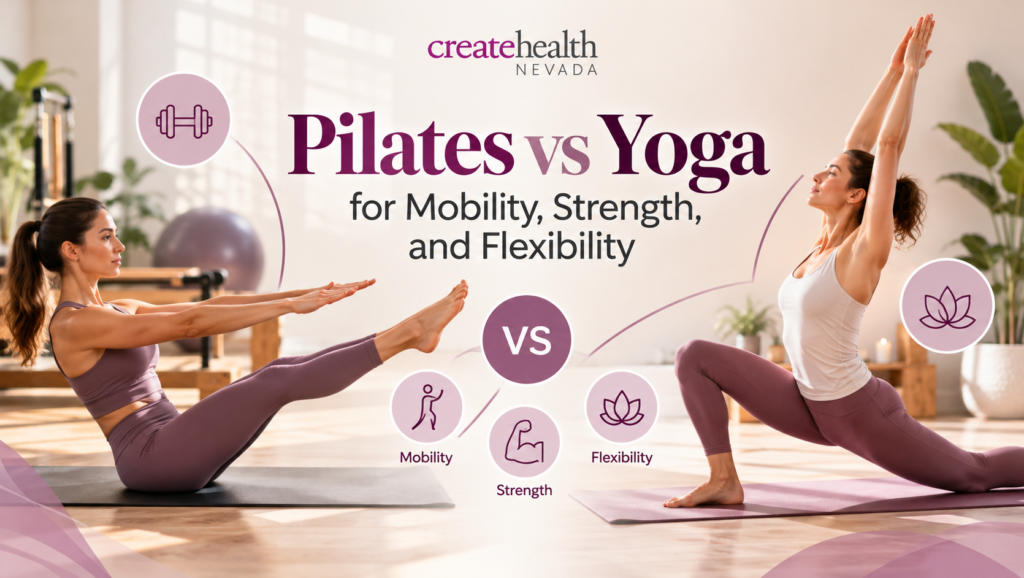
What Is the Difference Between Pilates and Yoga?
Pilates and yoga can look similar at first. Both involve moving with control, paying attention to your posture, and working with your breathing.
But once you try them, you will see some differences.
Pilates builds the strength and control you need to move comfortably, while yoga offers more opportunities to build flexibility and balance.
Neither is automatically better for everyone. It really comes down to what you want to improve and what feels difficult when you move.
How Does Pilates Help With Mobility?
Mobility isn’t just stretching; it also involves joint movement and enough muscle strength to control those movements.
This is where Pilates comes in: it uses slow movements to train muscles in the hips, shoulders, spine, and core.
1. It Builds Strength While You Move
Think about lifting your leg, reaching overhead, or turning to look behind you. These movements need more than flexibility. Your muscles also need to support and control your body.
Pilates helps you build both strength and mobility. For example, some exercises strengthen your core while you move your legs without losing control of your hips.
2. It Helps You Move Your Spine
Sitting for hours can leave your back feeling stiff. Pilates includes exercises that bend, turn, and move your spine in different ways.
These movements help you use your range of motion and notice which ones feel easy and which feel more difficult.
3. It Builds Stability Around Your Hips and Shoulders
Your hips and shoulders need to move freely, but they also need strong muscles to support them.
Pilates works on both. For example, you might move one leg while keeping your hips steady. Other exercises help you move your arms while keeping your upper body in control.
Over time, these exercises can help you control your body better during everyday activities.
How Does Yoga Help With Mobility?
Yoga works on mobility in a different way. Depending on the style, you may hold a pose for a few breaths, move through a series of poses, or spend time stretching certain parts of your body.
Some yoga classes are slow and gentle, while others involve more challenging movements.
1. It Helps You Work on Flexibility
Flexibility is about how much your muscles and other tissues can stretch. Mobility is about how well you can move through a range of motion.
Yoga often includes poses that stretch your hips, hamstrings, shoulders, chest, and back.
For example, a forward fold stretches the back of your legs, while a seated twist lets you practice turning your upper body.
With regular practice, yoga may help improve flexibility. Your results will depend on your body and how often you practice.
2. It Helps With Balance and Body Awareness
Standing on one leg might sound easy, but it can be harder than you think.
Yoga includes poses that help you practice balance and control. Tree pose is one example. Stand on one leg and place the other foot against your standing leg at a comfortable height.
Holding this position takes focus and small adjustments to stay balanced.
These poses can also help you pay more attention to how you stand, shift your weight, and move your body.
Research also gives us a reason to pay attention to balance.
11 studies reported improvements in at least one balance measure among people who practiced yoga. However, the National Institutes of Health notes that results can vary depending on the type of yoga and the people taking part in the studies.
3. It Gets You Moving in Different Ways
If you spend most of your day sitting at a desk or driving, you may not move your body through many different positions.
Yoga gives you a chance to change that. Depending on the class, you may stretch your arms overhead, move your hips, bend your spine, or turn your upper body.
You also move between standing, sitting, kneeling, and lying positions.
You don’t have to push yourself into a deep stretch. Start with poses that feel comfortable and work within your range of motion.
Pilates vs Yoga for Mobility: A Side-by-Side Comparison
Both practices can support mobility, but they tend to place their emphasis in different areas.
| Area | Pilates | Yoga |
| Main focus | Core strength, stability, and controlled movement | Postures, flexibility, balance, and body awareness |
| Flexibility | Works on flexibility through controlled movement | Often includes dedicated stretching positions |
| Strength | Builds strength through controlled exercises | Builds strength through weight-bearing poses and other movements, depending on the style |
| Joint movement | Practices moving joints with control and stability | Explores different positions and ranges of movement |
| Balance | Challenges balance through stability and coordination exercises | Often includes standing balance poses |
| Breathing | Coordinates breathing with movement | Uses breathing in movement, posture work, and sometimes meditation |
| Equipment | May use a mat, resistance bands, or specialized Pilates equipment | Often practiced on a mat, with optional blocks, straps, and other props |
Keep in mind that neither follows a set pattern or regimen. Gentle yoga classes could be totally different from flow classes. Mat Pilates sessions can also differ greatly from reformer classes.
Many factors affect how much you get out of your session.
Which Is Better for Tight Hips and Hamstrings?
If your hips or hamstrings feel stiff, try yoga. Many yoga poses address this problem: some target the front of the hips, and others target the back of the legs.
Pilates can also help in your case because it increases hip mobility while building strength and control.
However, if climbing stairs or getting out of a chair causes hip stiffness, you need not only stretching but also strength training.
It depends on the reason why your hips are stiff. If the problem doesn’t go away for a long time, it is better to consult a doctor.
Which Is Better for Back Mobility?
While both Pilates and yoga can help improve back mobility, they do so through different techniques.
Pilates uses controlled movements to build core strength that helps you move your spine with ease.
Yoga involves twisting, side bending, and forward folding to help you move your back in various ways.
If your back muscles feel tight from sitting for several hours, movement can help. However, if you have chronic back pain, you may need to do specific exercises.
Avoid any movements that worsen your back pain.
Medical attention should be sought immediately in case one has sudden back pain alongside other symptoms such as weakness, numbness, or problems with urination or defecation.
Can You Do Pilates and Yoga Together?
Absolutely!
Pilates allows you to develop muscle strength and control, and yoga will provide you with opportunities to increase flexibility and balance skills. So, combining Pilates and yoga is a great way to improve mobility in different ways.
For instance, if it is hard for you to lift your arms, you might need to strengthen your shoulders, improve your flexibility, and increase upper-back mobility.
One may start with a couple of beginner classes per week and monitor the reactions of his or her body.
How Do You Know Which Practice Your Body Needs?
Think about what makes movement difficult.
Are your hips tight because of prolonged sitting? Do you have difficulty with forward bends? Do you reach an end range of motion, but find it hard to control?
To develop strength and control, Pilates is likely the right choice. To develop flexibility and balance, yoga is likely the right choice.
It’s possible to explore each of these approaches and discover which one is most helpful for you.
Keep in mind that stiffness doesn’t necessarily mean that you need stretching. Injuries, joint pathologies, muscle weakness, and other factors may affect mobility. If you’re uncertain about what limits your mobility, consult your doctor.
What If Pilates and Yoga Don’t Help With Your Mobility?
Sometimes, you exercise regularly but still struggle with certain movements. You may stretch your hips or strengthen your core without noticing much change.
At Create Health Nevada, SomaFlow Therapy™ takes a whole-body approach to movement restrictions and areas of tension. Instead of focusing only on the uncomfortable area, the practitioner looks at how different parts of your body work together.
For example, if turning your neck feels difficult, they may also look at how your shoulders and upper back move.
SomaFlow is different from Pilates and yoga, and it isn’t a replacement for medical care. Whether it’s suitable for you depends on your needs.
If stiffness or limited movement makes everyday activities difficult, contact Create Health Nevada to discuss your concerns and see whether SomaFlow Therapy™ may be right for you.
People Also Ask
Which exercise, Pilates or yoga, would be better for improving mobility?
Both Pilates and yoga would improve mobility. Pilates focuses on building strength and control, while yoga focuses on stretching and balance.
Would yoga help improve not only flexibility but also mobility?
Yes, yoga can increase joint mobility by improving flexibility and range of motion.
Can Pilates help with stiff joints?
Pilates could be useful for building strength and exercising controlled movement; however, in case of joint pain or stiffness, consult a specialist.
How often should I exercise in order to increase mobility?
Gradually increase the frequency of Pilates and yoga exercises based on how you feel and what you need.
Is there a difference between SomaFlow Therapy™ and Pilates or yoga?
No, Pilates and yoga focus on movement, while SomaFlow Therapy™ focuses on the body’s movement and its tension spots.