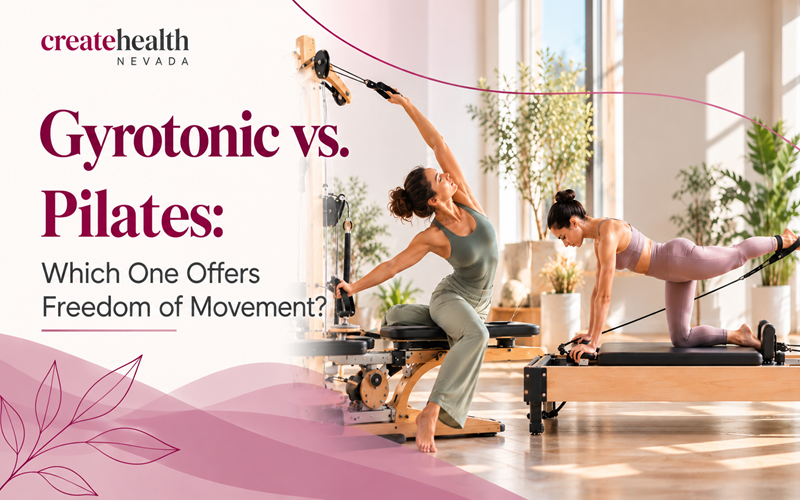
Pilates uses controlled, precise movements with a strong focus on stability and core strength. Gyrotonic uses flowing, circular, and spiral movements to work the body through a wider range of motion.
If you want to improve strength, flexibility, balance, and the way your body moves, both Gyrotonic and Pilates can help. The main difference is how they move the body.
At Create Health Nevada, we use personalized movement to help people improve mobility and physical function. Our services include Gyrotonic Training & Rehabilitation, Virtual Pilates, SomaFlow Therapy™, and personalized movement support.
Not sure whether Gyrotonic or Pilates is a better fit for you? Book a meeting with Create Health Nevada to talk about your movement goals and learn which approach may be right for you.
What Is Pilates?
Pilates is a movement system developed by Joseph Pilates. It focuses on controlled movements, body awareness, breathing, posture, balance, and strength.
Many Pilates exercises focus on the core, which includes the muscles around your abdomen, pelvis, back, and hips. Stronger core muscles can help you control your movements and maintain better support during everyday activities.
You can practice Pilates on a mat or use equipment such as a Reformer, Cadillac, or Pilates Chair. The equipment can add resistance or support, depending on the exercise.
Pilates also places a lot of value on control. Instead of rushing through an exercise, you focus on how your body moves.
For example, you are reaching down to pick up a box. Pilates can teach you to keep your core steady and control your movement as you bend and return to standing.
For example, imagine you are doing a leg exercise. Pilates may ask you to keep your pelvis steady while you slowly move your leg. This teaches you to control one part of your body while keeping another part stable.
Research also supports Pilates as a useful form of exercise for people with chronic low back pain. A 2023 review of 19 randomized controlled trials involving 1,108 people found that Pilates may improve pain and physical function in people with chronic low back pain.
That does not mean Pilates works better for everyone or that it can cure chronic pain.
What Is Gyrotonic?
Gyrotonic is a movement method that uses flowing, circular, and spiral movements. Juliu Horvath, a dancer, developed it from his own movement work.
Unlike many traditional exercises that move mainly forward and backward, Gyrotonic allows the body to move in several directions.
Think about reaching behind you to grab something from the back seat of your car. Your spine turns, your shoulders move, your hips adjust, and your arm reaches back. Your body works together rather than moving as separate parts.
Gyrotonic exercises can help you explore these everyday movements in a slow, controlled way.
The official Gyrotonic method describes the practice as a way to support strength, flexibility, balance, and more freedom of movement.
The method also uses specialized equipment and can be adapted to different abilities.
Gyrotonic vs. Pilates: The Main Differences
Both methods can build strength and body awareness, but the movement experience feels different.
1. Linear Movement vs. Circular Movement
Pilates often uses controlled and more linear movement patterns. You may move your arms or legs through a specific path while keeping the rest of your body stable.
Gyrotonic uses more circles, spirals, curves, and flowing sequences.
This difference matters because your body needs more than one type of movement in everyday life.
Think about getting out of a car. You turn your body, reach, twist, and shift your weight. Think about putting something on a high shelf. Your spine, shoulders, hips, and arms work together.
Gyrotonic can explore these types of three-dimensional movement in a controlled setting.
2. Stability vs. Mobility
Pilates often focuses on stability and control. You learn how to support your body while moving your arms, legs, or spine.
Gyrotonic puts more attention on continuous movement and mobility. It lets you explore movement through curves and spirals while maintaining control.
Neither goal is more important.
Your body needs both stability and mobility.
If you have good mobility but poor control, certain movements may feel difficult. If you have strength and stability but very limited mobility, everyday movements may also feel restricted.
A good movement program considers both.
3. Different Equipment
Pilates equipment often uses springs to provide resistance or assistance. The Reformer is one of the best-known examples.
Gyrotonic uses specialized equipment with pulleys, weights, and handles. This setup lets you perform circular, flowing movements while working against resistance.
The equipment also gives an instructor more ways to adjust an exercise to your current ability.
4. Different Movement Feel
Pilates can feel focused and precise. You may repeat an exercise while paying close attention to your posture, breathing, and muscle control.
Gyrotonic often feels more continuous. One movement can flow into another, with the spine, arms, legs, and breath working together.
For some people, Pilates feels easier to understand at first because the exercises have clear positions and instructions. Others enjoy Gyrotonic because they like the feeling of moving continuously.
| Feature | Pilates | Gyrotonic |
| Movement style | Controlled and precise | Flowing and circular |
| Main focus | Strength, stability, and control | Mobility, flexibility, and fluid movement |
| Movement patterns | Often straight and controlled | Curves, spirals, and circles |
| Equipment | Reformer, springs, and other equipment | Pulleys, weights, handles, and specialized equipment |
| Movement feel | Focused and structured | Continuous and flowing |
| Body awareness | Focuses on posture, breathing, and control | Connects the spine, limbs, breath, and movement |
Which Is Better for Chronic Pain?
There is no simple answer.
If you live with chronic pain, the goal should not simply be to find the exercise with the best name. The better question is: Which type of movement can you do safely, consistently, and comfortably while working toward your goals?
Research gives us useful information about Pilates, especially for chronic low back pain. Studies show that Pilates can improve pain and function compared with minimal or usual care. However, research also shows that Pilates does not clearly outperform other forms of exercise.
Research on Gyrotonic is not as extensive, so we should be careful about making strong claims about its effects on chronic pain.
That does not mean the method has no value. It means we need to separate what people experience from what research has firmly proven.
At Create Health Nevada, we focus on more than choosing one exercise method. The team looks at how a person moves, where movement feels restricted, and what habits may affect comfort and function.
A Simple Example!
Imagine two people who both complain about stiffness.
Person A sits at a desk for eight hours each day. They want better core strength, posture, and body control. They may enjoy Pilates because the exercises give them a clear way to work on strength and control.
Person B feels stiff when turning, reaching, or moving through different directions. They want to explore more flowing movement and improve their range of motion. Gyrotonic may feel like a better fit.
But these are only examples. A person’s history, current movement ability, comfort level, and goals should guide the choice.
Can You Do Both Pilates and Gyrotonic?
Yes. You do not have to choose only one.
Pilates can give you a strong foundation in control, stability, and strength. Gyrotonic can add more circular and three-dimensional movement.
The two methods can complement each other. The official Gyrotonic website also highlights how movement professionals use Gyrotonic and Pilates together because each method can support the other.
For example, someone might use Pilates to build strength and control around the hips and trunk, then use Gyrotonic to explore more fluid movement through the spine and hips.
The goal is not to collect different exercise methods. The goal is to find movement that helps your body function better.
How Can Create Health Nevada Help?
At Create Health Nevada, movement starts with the individual.
The team looks at movement patterns, areas of restriction, past injuries, and daily habits before choosing an approach. Our goal is to improve your mobility, function, body awareness, and confidence in movement.
Gyrotonic Training & Rehabilitation offers flowing, spiral movement.
Virtual Pilates provides personalized instruction to improve posture, flexibility, balance, core strength, and movement confidence.
SomaFlow Therapy™ adds a movement-based approach that combines somatic awareness, fascia-focused work, and movement retraining.
This matters because no two people move in the same way.
Someone who wants to return to an active lifestyle may need a different plan from someone who simply wants to walk, sit, sleep, or move around the house with greater ease.
The Bottom Line!
Gyrotonic and Pilates both help you move better, but they work differently. Pilates focuses on strength, control, and stability, while Gyrotonic uses smooth, flowing movements to improve mobility.
Neither is better for everyone. The right choice depends on your body and your goals.
At Create Health Nevada, we teach you how to understand your movement and build better ways to move with ease and confidence.
People Also Ask
Is Gyrotonic better than Pilates?
Neither method is better for everyone. Pilates focuses more on controlled movements, stability, and core strength, while Gyrotonic uses flowing, circular, and spiral movements. The right choice depends on your body, goals, and movement needs.
Can beginners do Gyrotonic?
Yes. Beginners can learn Gyrotonic with a trained instructor. The exercises can be adjusted to match your current ability, movement experience, and goals.
Is Gyrotonic good for flexibility?
Gyrotonic can help you explore a greater range of motion through flowing, spiral movements. It combines mobility with strength and control rather than focusing only on stretching.
Can I do both Gyrotonic and Pilates?
Yes. You can combine both methods. Pilates can help you build strength and stability, while Gyrotonic can help you explore more fluid and multidirectional movement.
Which is better for improving mobility, Gyrotonic or Pilates?
Both can support better movement, but they approach mobility differently. Gyrotonic focuses on flowing, circular, three-dimensional movement, while Pilates combines mobility with controlled strength and stability work.
Can Gyrotonic and Pilates help with chronic pain?
Movement-based exercise can help manage chronic pain and improve physical function, but results vary from person to person. If you live with chronic pain, a trained professional can help you choose movements that match your needs and abilities.